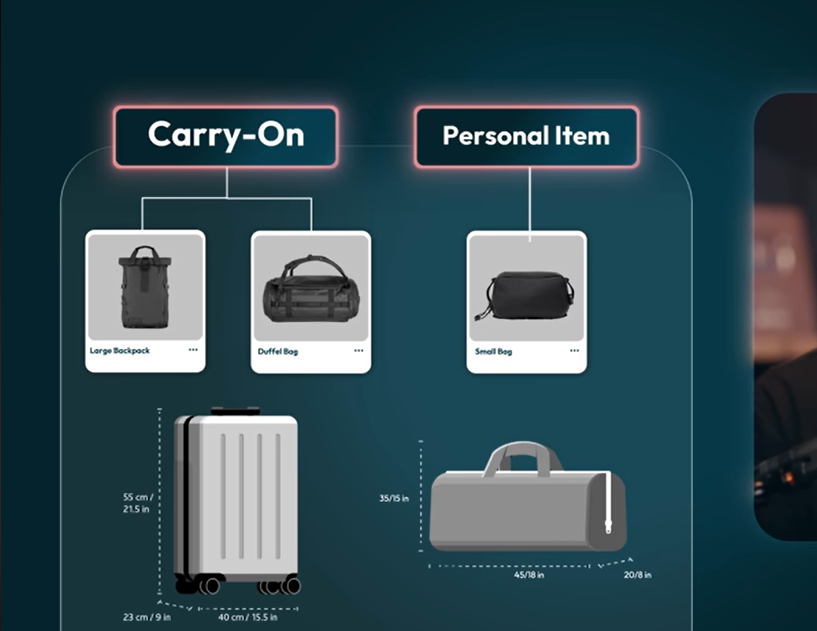
To measure carry-on luggage size, use a measuring tape to check the bag’s height, width, and depth, including wheels, handles, and side pockets. Airlines typically list maximum carry-on dimensions (such as 22 x 14 x 9 inches), and your bag must fit within those total measurements. Measure from the floor to the top of the handle (when fully retracted), across the widest part, and from front to back at the deepest point. Always compare your measurements with your airline’s specific size limits before traveling to avoid gate-check fees.
The Best Tools for Accurate Luggage Measuring
Don’t rely on a floppy sewing tape measure or “eye-balling” it. These specific tools are used by pro travelers to avoid $50+ gate-check fees.
Product Why it’s the Best for Measuring Key Feature Etekcity Digital Luggage Scale Weight & Size Combo. Essential for budget airlines like easyJet or Spirit. High-precision sensor & easy-grip handle. Self-Locking Steel Measuring Tape Best for Rigid Accuracy. Won’t bend or sag like fabric tapes. 16ft length, perfect for all suitcase sizes. Traveler’s Choice 21″ Carry-On The “Safe Bet” Suitcase. Designed specifically to fit 22x14x9 sizers. Built-in USB port & hardshell protection.
Why Measuring Your Carry-On Size Actually Matters
I’ve learned the hard way that airlines aren’t joking about baggage rules anymore. One inch over can mean a surprise fee at the gate. Trust me, nobody wants to repack socks in front of a line of tired passengers at 6 a.m. on a rainy Tuesday. I once saw a traveler at JFK frantically sit on their suitcase to make it fit in the metal sizer. It didn’t work, and the zipper gave up before the airline agent did. Measuring your bag before you leave home saves you from that mid-airport meltdown.
The Real Cost of Getting It Wrong
Getting your dimensions wrong costs more than just pride; it hits your wallet and your schedule. If your bag is too big, you face:
- High Gate-Check Fees: These are often double the price of a prepaid checked bag.
- Forced Last-Minute Check-In: You lose the “cabin-only” perk and have to wait at the carousel later.
- Missed Boarding Time: While you’re busy rearranging heavy sweaters, the “Final Call” light is blinking.
- Risk of Damage: Your “fragile” carry-on might end up tossed into the cargo hold.
Why Airlines Enforce Carry-On Limits
It feels like a personal attack when an agent pulls you out of line, but there are practical reasons for the strict rules:
- Overhead Bin Space: There is only so much room in those metal bins. If one person brings a “trunk,” someone else loses their spot.
- Aircraft Balance: Pilots need to know the weight distribution to keep the flight smooth and safe.
- Boarding Speed: Flights stay on time when we can all stow our gear quickly and sit down.
I’ve found that being “close enough” isn’t a strategy. Modern planes are packed, and gate agents are trained to spot a bulging bag from twenty feet away. Taking five minutes to measure at home ensures your holiday starts with a coffee in your hand, not a credit card at the boarding desk.
Which Airlines Allow 55x40x20 Bags? -The 2026 Guide to Stress-Free Boarding
Standard Carry-On Size Dimensions (But They’re Not All the Same)
Before you grab a tape measure, you need to know your target. Here is the twist: your goal depends entirely on who you are flying with. I once packed for a sunny weekend in Florida thinking my bag was a “standard” size. I quickly found out that “standard” is a myth. Every airline has its own tape measure and its own set of rules.
Typical Domestic U.S. Airline Carry-On Limits
Most major U.S. airlines expect your bag to be around 22 x 14 x 9 inches. This includes the wheels and the top handle. I usually fly with Delta or United, and they generally stick to these numbers. However, I always check their app the night before a holiday. It takes two minutes and saves me a massive headache at the curb.
Budget Airlines Have Stricter Rules
Low-cost carriers like Spirit or Ryanair are much tougher. They make their money on fees, so they watch those bins like hawks. They often:
- Charge for full-size bags: Your “free” bag might only be a small purse.
- Shrink the limit: Their sizers are often smaller than the big airlines.
- Check at the gate: I’ve seen agents pull every third person aside to test their bag fit.
International Flights Can Differ
If you are heading to Europe or Asia, the rules change again. Airlines like Lufthansa or Emirates often use metric units. Instead of inches, you’ll need to think in centimeters. They also care deeply about weight. A bag that is the right size but too heavy will still get sent to the cargo hold.
Tools You’ll Need to Measure Carry-On Luggage Size
You don’t need fancy gadgets to get this right. You just need to be honest with your measurements.
Simple Tools That Work
I keep a small kit in my junk drawer for flight prep. It’s nothing special, but it works:
- Measuring tape: Use a flexible cloth one if you have it.
- A flat floor: Carpet can hide an extra half-inch of wheel height.
- Your phone: I snap a photo of the final numbers so I don’t forget them.
- A bathroom scale: This is vital for those strict international weight limits.
Why a Soft Tape Measure Works Best
I prefer a soft, flexible tape over the metal kind. Hard suitcases have curves and rounded corners. A metal tape stays straight, but a soft tape follows the shape of the bag. This gives you a true “real-world” measurement. When I’m squeezing my favorite boots into a soft-sided bag, the fabric bulges. A flexible tape helps me see if that bulge will make me fail the sizer test.
How to Measure Carry On Luggage Size (Step-by-Step Guide)
Learning how to measure carry on luggage size properly saved my last holiday to Mexico. It is not hard, but small slips can cost you. I used to just guess, but now I follow a strict routine on my living room floor. Most travelers make mistakes because they ignore the bits that stick out. Here is exactly how I do it to stay safe at the gate.
Step 1: Measure Height (Top to Bottom)
You must measure from the floor to the very top of the handle. Stand your bag upright on a hard floor. I once ignored the wheels on a trip to Denver and almost paid a fifty-dollar fee. Airlines count every single inch, including those tiny wheels and the fabric grip at the top. If it sticks out, it counts.
Step 2: Measure Width (Side to Side)
Lay the bag flat and measure the widest point. I always check the side handles and any outer pockets. On a busy Friday at the airport, a bulging side pocket can keep your bag from sliding into the overhead bin. Make sure you include anything that pokes out past the main frame of the suitcase.
Step 3: Measure Depth (Front to Back)
Measure the bag only when it is fully packed. This is a mistake I see all the time. An empty bag is slim, but a stuffed one grows like a balloon. Zip everything shut and tighten your straps. If your bag looks like a stuffed turkey, the gate agent will notice. I use my hands to press down the fabric and get a “real” number.
Step 4: Double-Check Expanded Sections
If you use the expansion zipper, you must measure again. Most bags have a zipper that adds two extra inches of space. I love that extra room for souvenirs, but it usually puts the bag over the limit. If you plan to fly with it open, make sure it still fits the airline rules. I usually keep mine closed just to sleep better the night before my flight.
Don’t Forget Weight Limits
Size is only half the equation because an overweight bag can be just as problematic as a large one. I learned this the hard way on a trip to Doha. I had my dimensions perfect, but the agent at the scale gave me a look that said, “Nice try.” Many international airlines are very strict about how heavy your bag is.
Common Weight Limits
Most international carriers allow between 15 and 22 lbs (7–10 kg). While major U.S. domestic airlines rarely pull out the scales, budget airlines and small regional jets do it often. I’ve seen Qatar Airways check every single bag in the boarding line. If you are flying on a small plane, every pound matters for the aircraft’s balance. Always weigh your bag at home so you don’t have to pay a fee at the desk.
Personal Item vs Carry-On — Know the Difference
The main difference is where the bag goes: a carry-on goes in the bin, but a personal item must fit under the seat in front of you. I’ve watched many travelers argue this at the gate, and it never ends well. Usually, they end up paying a fee while the rest of the line sighs behind them.
What Counts as a Personal Item
A personal item is usually a backpack, laptop bag, purse, or a small tote. It needs to be small enough that your feet still have a bit of room. On a weekend trip to Chicago, I realized my “small” backpack was actually a full-size hiking pack. The agent made me check it because it wouldn’t clear the seat frame.
Common Personal Item Size
Most airlines look for something around 18 x 14 x 8 inches. However, be careful with budget airlines. They often shrink these numbers to make you pay for a “real” carry-on. If your bag is bursting at the seams, it might not count as a personal item anymore.
How to Measure Soft-Sided vs Hard-Shell Luggage
You should measure these differently because fabric moves but plastic stays put. I own both types, and I’ve found that each has its own “trick” to get an honest reading.
Measuring Soft-Sided Bags
Pack the bag fully before you measure. Fabric stretches, and those outer pockets can bulge out several inches. I like to smooth out any lumps with my hands to see the widest point. If you have compression straps, pull them tight. It makes a huge difference in how the bag looks to a gate agent.
Measuring Hard-Shell Luggage
Focus on the fixed parts like wheels and handles. These bags are easier to measure because they don’t change shape. However, I’ve noticed that some “22-inch” hard bags don’t include the wheels in their labels. I always stand my hard-shell bag against a wall and mark the top point to be 100% sure. Check the side handles too; if they stick out too far, they might snag on the sizer.
Pro Tips From Frequent Travelers
These little habits save me a world of stress when I travel. I used to be the person sweating in the boarding line. Now, I have a routine that keeps me calm. I’ve learned that a few small tricks make the difference between an easy flight and a costly gate fee.
Smart Travel Habits
The best way to win is to stay ahead of the airline. Here is what I do:
- Carry a small tape: I keep a tiny cloth tape in my bag for quick checks.
- Save the rules: I screenshot the airline baggage policy before I leave. This helps if an agent seems unsure.
- Use packing cubes: These keep my clothes flat and prevent my bag from bulging.
- Aim low: I look for a bag that is 21.5 inches instead of 22. That half-inch buffer helps me sleep better the night before a flight.
When to Buy a New Carry-On
Sometimes the issue isn’t how you pack; it is the suitcase itself. If your bag is old, it might be time for a change. I had a trusty blue bag for ten years, but its bulky wheels finally made it too big for modern sizers. It was a sad day, but buying a new bag saved me money in the long run.
Signs Your Bag Is Oversized
You know your bag is a risk if it has big, protruding wheels. Many older models were built before airlines got strict. If your bag measures 23 inches with the handle, it will likely fail. If you struggle to drop it into an airport sizer, don’t risk it on your next holiday. It is better to buy a new bag than to pay a fifty-dollar fee every time you fly.
Features to Look for in a Carry-On
When I shop for a new bag, I look for a few key things. I want clearly labeled sizes on the tag. I prefer recessed wheels because they stay tucked in and out of the way. A lightweight build is also vital for those strict weight limits. Finally, look for an expansion zipper with a restraint. This keeps you from overfilling the bag by accident.
FAQs: How to Measure Carry On Luggage Size
Do airlines include wheels and handles in carry-on size?
Yes. Airlines measure the total exterior dimensions, including wheels, handles, and side pockets.
Should I measure my carry-on empty or packed?
Always measure it fully packed and zipped closed. Soft bags expand.
What is the standard carry-on size limit?
Most U.S. airlines allow 22 x 14 x 9 inches, but always check your specific airline.
How do I measure carry-on luggage correctly?
Use a tape measure and measure:
- Height (floor to top, including wheels)
- Width (widest side)
- Depth (front to back when packed)
Are carry-on weight limits enforced?
Sometimes. Many international airlines enforce weight limits (usually 15–22 lbs). U.S. airlines rarely weigh carry-ons.
What happens if my carry-on is too big?
You may have to gate-check it and pay an extra fee.
Is a backpack considered a carry-on?
It depends on size. Small backpacks count as a personal item. Larger ones may count as a carry-on.
How accurate are airport luggage sizers?
Very accurate. If your bag doesn’t fit easily into the metal sizer, it’s considered oversized.
Do international airlines use different measurements?
Yes. Many use centimeters (cm) and may have stricter weight rules.
How can I avoid carry-on size problems?
Choose a bag slightly under the maximum size and double-check airline rules before flying.

Md Abdul Muhaimen is an experienced travel content writer and guide who has a Master’s in Information Systems Management from the University of Huddersfield. He is passionate about all things related to travel logistics and trip planning, and has assisted thousands of readers in choosing the proper luggage, knowing which items can be included in carry-on luggage, and understanding an airline’s policy with confidence.
Md Abdul has a sound grounding in systems thinking and data-driven content creation that allows him to bring clarity to complicated travel topics — from comparing the exact sizes of cabin bags from multiple airlines to developing helpful how-to guides to simplify a traveler’s experience.
He actually engages in travel forums on Quora, answers real user questions, and shares insights by posting on Medium blogs
.His work marries first-hand research, consumer-focused advice, and technical accuracy, and he is a voice that can be trusted among the travel and luggage community.